
Having a flexible Cystoscopy
Telephone numbers for Cystoscopies
Reception 01305 2556793
Appointment enquiries 01305 255701
Clinical advice (enquiries about preparation) 01305 255145
If you call the Clinical Advice line and your call goes to answer phone, please leave the following details:
•Name and telephone number
•The procedure you are having
•Date and time of appointment
•Your hospital number or NHS number (see appointment letter left hand corner at top)
•Your query
Someone will return your call as soon as possible to discuss your telephone message with you.
Unfortunately, due to the nature of the investigations and individual needs of each patient it is not always possible to run to time. The staff will endeavour to keep you informed of any delays.
The car parking is pay and display. You will need to pay for the first 2 hours. When you enter the hospital grounds, follow the signs for the Urology Suite, Fleet Outpatients, North Wing, Entrance 1, Level 1.
Planning your care
If you have any of the medical conditions listed here or are taking any of the following medications, please call the clinical advice line to help us plan appropriate care and management of your condition during your visit with us:
| Do you have: | If you answered ‘yes’ |
| Diabetes | No action required |
| Recent heart attack | Call clinical advice line on 01305 255145 |
| Aspirin or Dypridamole therapy | No action required |
| Warfarin therapy | No action required |
| Blood thinners such as Clopidogrel Prasugrel, Ticagrelor | No action required |
| Blood thinners such as Dabigatran, Rivaroxaban, Apixaban, Edoxaban | No action required |
| If you are pregnant | Call clinical advice line on 01305 255145 |
Please continue all medications as usual.
Our aim is to make your visit as comfortable and as pleasant as possible. Please be reassured that during both admission and recovery your privacy will be respected, and we will be sensitive to your needs.
Having a Flexible Cystoscopy
This leaflet will explain what this is and will inform you of what to expect when you visit the Urology Suite.
Where will I have my Flexible Cystoscopy?
Your Flexible Cystoscopy will be performed in the Urology Suite, Fleet Outpatients, North Wing, Entrance 1, Level 1.
What is a Flexible Cystoscopy?
The term comes from the Greek word cysto, meaning bladder. A Flexible Cystoscopy is a procedure where an Endoscopist can look at parts of your urinary system using a flexible telescope.
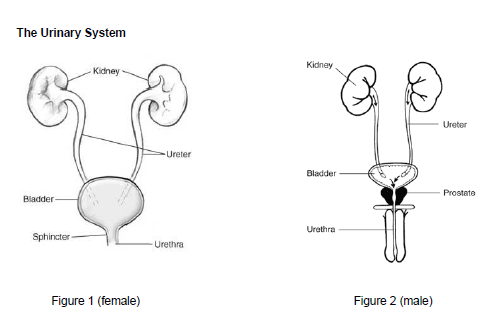
The kidneys produce urine, which travels through the ureters to the bladder where it is stored. The bladder is a muscular bag which, when full, is about the size of a grapefruit. When the time comes to pass urine, the muscle wall squeezes the urine out into the urethra. In women the urethra is only about one inch long. In men it is much longer and passes through the prostate gland. Both men and women have muscular valves called sphincters, which control the flow of urine.
The Flexible Cystoscopy
This is a look inside the urethra and bladder with a small thin flexible telescope (called a cystoscope). It only takes a few minutes and, although people may find it a bit uncomfortable, it should not be painful.
Why have a Flexible Cystoscopy?
The purpose of a Flexible Cystoscopy is to see if there are any abnormalities of the bladder or the urethra. The pictures will show any areas of inflammation or other abnormalities. Many examinations show a healthy urinary tract.
What are the benefits of having a Flexible Cystoscopy?
During a Flexible Cystoscopy the lining of the bladder and the urethra can be very clearly seen. It is an excellent way to get a diagnosis of your symptoms or to reassure you that all is well. The cystoscope has a hollow tube inside that can is used to fill the bladder with sterile water. It can also be used to remove urinary stents.
Is there an alternative to Flexible Cystoscopy?
There is no other investigation that can provide your doctor with all this information. If you are unsure about this examination, please seek more information from the clinician who referred you.
Possible side effects in having a Flexible Cystoscopy
- Urinary Symptoms – sometimes a mild burning on passing urine can be experienced. This usually gets better after a day or so.
- Blood in the urine – a little bleeding can be common after this procedure but should settle after a day or so.
- Urine infection – this is an occasional problem after a Flexible Cystoscopy. If you develop a temperature, pain, persistent burning or bleeding then you need to contact your GP. who may need to prescribe some antibiotics
Preparing for your Flexible Cystoscopy
There is no special preparation for the test. You can eat and drink as normal. As the test does not involve any sedative injection you can drive yourself to and from the appointment.
When you get to the Urology Suite
You should allow approximately 1 hour for your Flexible Cystoscopy. It is not unusual to feel anxious. The Nurses and Doctors understand this and will do their best to reassure you.
When you come to the Urology Suite please give your name to the Receptionist. A Nurse will come and meet you and take you through to a private office. They will ask you some questions about your health.
Please bring a list of your medications with you.
Please bring a urine sample with you. If there is a possibility of an infection, we will be unable to proceed with the flexible cystoscopy.
Please tell the Nurse if you are allergic to any medicines.
You can ask any questions that you have or tell the nurse of any worries.
It is not necessary for you to change into a hospital gown for the procedure; however, the Nurse will offer you the opportunity to do so if you wish. Your privacy and dignity will be respected at all times.
You will be asked to empty your bladder before the procedure.
Consent
The Nurse, who is a member of the Urology team, will meet you and talk to you about the procedure. It is important that you understand what is likely to happen and that you have asked any questions that you may have. This will help you make the decision whether to go ahead with the procedure.
The Procedure
You will be introduced to the staff working in the treatment room, who will ask you to lie on your back on the trolley. You will then be covered by a sterile sheet.
The Nurse will then use some mild antiseptic solution to clean around the genital area. Some local anaesthetic jelly will then be squeezed into the urethra. This may sting for a brief time. The Nurse will then insert the tip of the instrument into the urethra and onwards to the bladder.
Men may experience a slight stinging sensation as the cystoscope passes through the sphincter muscle below the prostate. Relaxing the stomach muscles at this point will help allow the cystoscope to pass easier and may ease the stinging.
When the bladder is empty there are folds in the lining. Sterile water is run into the bladder through the cystoscope to stretch out the folds so that all of the bladder can be seen.
Sometimes the urethra can be narrow, so it may be necessary to carry out a slight stretching of the area.
The nurses will explain exactly what they are doing throughout the procedure.
Afterwards the Nurse will talk to you about what has been found and discuss with you any further action that needs to be taken.
Going Home
The nurse will give you some discharge advice and some instructions to follow for a few days after the Flexible Cystoscopy. Please follow all the advice carefully.
If you experience any problems related to your visit, including the need to see your GP or attend hospital, please let the department know. A brief written summary would be helpful. We welcome all feedback to enable us to further improve the service offered.
Patient Property
You are advised not to bring expensive items of jewellery or clothing with you when you visit Fleet Outpatients.
You will be given a patient property bag to place your clothes in if changing for your procedure and asked to keep your property with you at all times.
Fleet Outpatients and Dorset County Hospital NHS Foundation Trust cannot accept responsibility for the safeguarding your property.
About this leaflet:
Author(s): Andy Goffe, Urology Nurse Consultant
Written: February 2025
Approved: February 2025
Review Date: February 2028 (3 years after date approved)
Edition: Version Number 5