Having a DXA (Bone Density) Scan
About having a DXA scan
Your healthcare professional has referred you to South Walks House for a bone density scan.
A bone density scan will assess if you have osteoporosis (weak bones) and your chance of future broken bones (sometimes called ‘fractures’). This is important because bone health can be improved. Steps can be taken to strengthen bone and lower the chance of broken bones.
What is a DXA scan?
Bone density scans or ‘DXA’ scans (which stands for Dual energy X-ray Absorptiometry) use low dose x-rays to measure your ‘bone density’. Bone density is how solid the inside of your bones are. Bone density is just one factor that helps us to understand the strength of your bone. Other factors, such as your age, family history and medical history will be considered alongside your scan result.
This will help us to assess your bone health and your chance of future broken bones.
A bone density scan does not provide any information about cancer, arthritis or causes of pain.
What does it involve?
You will be sent a questionnaire with your appointment letter, please complete both sides of the questionnaire and bring it with you on the day of your appointment.
Your weight and height will be measured before the scan.
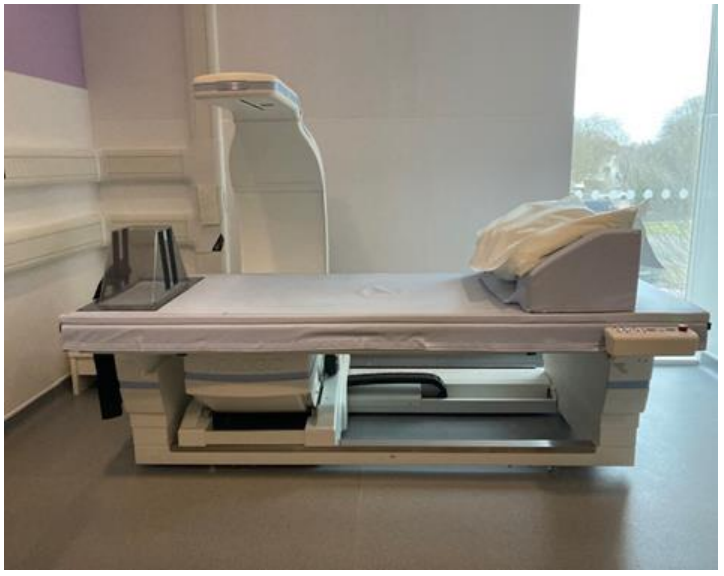
The bone density scan appointment is simple and takes about 20 minutes. You will be asked to change into a hospital gown, a private space is provided.
You must be able to transfer onto the scanning table with minimal assistance. The table is a fixed height of 68cm. You must weigh less than 204kg (32 stone).
You will be asked to lie on a scanning table where the slow moving ‘arm’ of the scanner will pass over your body. This scanner will measure the bone density at one hip and your lumbar spine, occasionally we will scan your wrist. The scan is carried out by a radiographer or technician who has had training to perform theses specialist scans. Occasionally a student may be present.
You are not enclosed during the scan (NO TUNNELS) and there are no injections.
For your lower back measurement, we need you to rest your legs on a raised block. This helps to keep your back straight and makes you more comfortable. For the scan of your hip, we move your feet so that they face slightly inwards. This gives us a clearer picture of your hip.
Do I need to prepare for the scan?
We ask you not to take any calcium supplementations for 24 hours before your scan. Please eat and drink normally and take any prescribed medications (apart from calcium supplements).
Is the x-ray radiation dose harmful?
The amount of radiation from a bone density scan is very low and much lower than most other x-rays or scans. The amount is about the same as you would be exposed to naturally in 3 days.
Is there anything I should tell the radiographer before the scan?
If you are pregnant, please let us know as soon as possible and we will re-schedule your scan. If you have two hip replacements and /or back surgery, please tell us.
Who will be present for the scan?
The scan will be performed by a trained radiographer who specialises in bone density. Occasionally student radiographers may be present to observe the scan.
How long can I expect to wait to hear the results of my scan?
The results of your scan will be sent to the healthcare professional who referred you for the scan. This is within three weeks, but this can vary. The department will tell you what waiting times to expect.
If you have not received your results within the expected time, you should contact the healthcare professional who referred you to ask if the results are available. If you are unsure who referred you for your scan, ask the health professional undertaking your scan.
What happens to the results of the scans?
Depending on the result of your bone density scan, you may be asked to have further tests, such as a blood test or spine x-rays.
You may be offered bone strengthening medicine if you have an increased chance of broken bones. This will include some, but not all, people with:
- Osteoporosis
- Low bone density (sometimes called osteopenia).
You will only be offered bone strengthening medicines if you have an increased chance of broken bones. Other factors, such as your age, family history, and medical history will be considered alongside your scan result.
You should also be told if you need a follow-up bone density scan and when. Follow-up scans are not usually repeated until a minimum of two years have passed; however, the interval can be longer. This is because bone density changes slowly over time.
Cancelling your appointment
If you are unable to attend your appointment, we would be grateful if you could contact us as soon as possible on 01305 255161.
You may be asked to leave a message and contact number so we can rearrange your appointment to suit you and offer your original appointment to another person.
If you are arriving by hospital transport, please ring 01305 255161 and inform us so we can ensure you are given an appropriate appointment time.
Please arrive on time and allow 30 minutes for the whole procedure.
Contact numbers
We hope that you have found this information useful. If you have any questions or are worried about anything, please speak to the following Dorset County Hospital staff:
Department: 01305 255161
Dorset County Hospital Switchboard: 01305 251120
Patient Experience team: 0800 7838058
Further information on Osteoporosis and Bone Health can be obtained from:
Royal Osteoporosis Society
Free nurse helpline: 0808 800 0035 (available Monday to Friday, 9am to 12.30pm and 1.30pm to 5pm).
Website: theros.org.uk
Email: nurses@theros.org.uk
About this leaflet
Author: Sue Edwards, Lead DXA Radiographer
Written: April 2022
Updated and approved: December 2025
Review date: December 2028
Edition: v4
If you have feedback regarding the accuracy of the information contained in this leaflet, or if you would like a list of references used to develop this leaflet, please email patientinformation.leaflets@dchft.nhs.uk
Print leaflet