
Colorectal Telephone Assessment Clinic
This leaflet provides a guide to what will happen now that your doctor has referred you to the colorectal (bowel) team.
Have you got bowel symptoms?
Your doctor (GP) believes that you may have a problem with your bowel. They have referred you to the hospital to have an appointment with the colorectal (bowel) team for some tests or to see a specialist.
We know that bowels can be an embarrassing subject and difficult to talk about. We want you to feel as comfortable as possible talking about your bowels. Please use whatever words you find easiest to describe what has been happening. If you can talk freely about your problems, this helps us to find out more information which helps us to assess your symptoms.
Most people with bowel symptoms do not have cancer, but it is important to have your symptoms checked out. The cause is usually something minor like piles, irritable bowel syndrome or diverticular disease. If you have piles these can possibly be treated at the time of your test.
This booklet will explain how the colorectal telephone assessment clinic works and what to expect when we call you. It also has some information about the types of tests we might arrange for you.
What will happen now?
Your doctor has referred you to the Colorectal Telephone Assessment Clinic.
When your GP booked you in for this appointment you will have been asked to supply a telephone number (mobile or landline). You will have been sent a letter confirming a date and time for a colorectal telephone assessment appointment. A colorectal specialist will call you on the number that you supplied at the specified date and time. The clinics usually run on time, and you should be called within 20 minutes of your appointment. If you would like to give a new contact telephone number or change your appointment time, please ring 01305 255779.
Please let us know if you have a call barring system on your telephone as calls made from the hospital are displayed as anonymous.
Please make sure you are available to answer the call. You do not need to attend the hospital for this telephone appointment.
During this telephone call you will be asked questions about your health, your symptoms and your personal circumstances. The colorectal specialist will advise what tests you need to have. You will then be contacted by telephone to confirm a date before being sent an appointment for this test. Most tests take place within six weeks. It is helpful if you can tell us of any holidays you may have planned, or dates when you are not able to come to hospital for tests.
What tests am I likely to need?
Different tests give us different information about you and your bowels. The most common tests are:
- Flexible sigmoidoscopy
- Colonoscopy
- Gastroscopy
- CT colonography
- CT scan
- Ultrasound scan
- Blood tests
- Stool tests.
Descriptions of these different tests are listed in the glossary at the back of this booklet. If blood tests are needed, we will send you a letter with a blood test form. We will ask you to make an appointment with the nurse at your GP surgery and take the form with you.
You can also have your blood test taken at Dorset County Hospital Outpatient Department from 8.30am to 2pm, Monday to Friday, or at Weymouth Community Hospital from 8.15am to 2pm on a Monday and Wednesday.
Most people are booked for one of these tests. However, in some cases, we may ask you to come to the out-patient department first for a face-to-face appointment. The colorectal specialist will explain the test to you and answer any questions that you may have. You will be sent more information about the test including any risks and benefits in the post.
What if I choose not to have the tests that are recommended?
You will have an opportunity to discuss this with the colorectal specialist at your telephone assessment appointment. There may be alternatives that you are happy to have. If you do not want to have the tests that we recommend, you should discuss this with your GP.
What happens after I have had my investigation or test?
There will be three possible situations that could occur after you have had your test:
- In some cases, we will be able to tell you your results at the time of your test. We will be able to offer you treatment straight away or refer you on for treatment.
- For some people more tests may be needed, and we will arrange these for you. If you have had a scan, you will be contacted either by telephone or letter with the results. Please contact us if you have not heard anything within a few weeks of your test.
- In all cases we will write to you to confirm your results and give you advice. Your GP will also receive a copy of all the results from your tests.
Useful tips
It is helpful if you think about your symptoms carefully before your telephone assessment.
Your symptoms:
- What has been happening with your bowels?
- How long have the symptoms been going on?
- Are they continuous or do they come and go?
- Is there any pattern, eg same time of day, before or after meals?
- If you have pain, where is it? What is it like? How long does it last for?
Change in your lifestyle:
- Have you changed your diet or exercise?
- Have you recently felt stressed?
- Have you been overseas lately?
- Have your friends, family or colleagues had similar problems?
- Are you on any new medication?
Your medical history:
- Have you had any bowel or digestive problems in the past?
- Have you had any operations?
- Do you have any heart problems?
- Do you take any blood thinning medicines?
- Are you diabetic? If so, do you take tablets or insulin?
Family medical history:
- Have any of your family members had cancer, especially bowel cancer?
- Have any of your family members had a bowel disorder such as Crohn’s Disease or Colitis?
Your person circumstances:
- Do you live alone?
- How mobile are you/do you need help getting around?
- What support do you have around you?
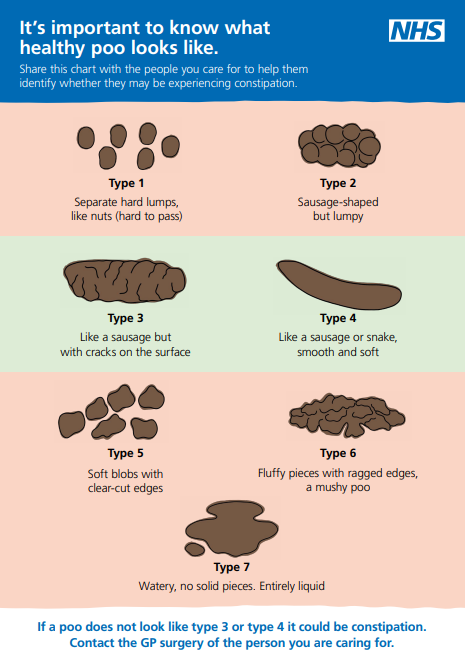
You may find the Bristol Stool Chart below helpful to describe how your bowels are working:
Commonly questions
Who is my consultant?
Julie Lane, Colorectal Nurse Consultant, is the clinician responsible for your care. You will be assessed by Julie Lane or by our Nurse Practitioner, David Oglesby.
Why am I not being seen in person in clinic?
We have provided a colorectal telephone assessment service since 2008. We believe that a colorectal specialist can make a safe and effective assessment over the telephone. Most patients need a test, and this can be arranged without being examined. Feedback from patients and GPs has been very positive. People have told us that this system is more convenient and saves them a journey to hospital. If you do not want to have a colorectal telephone assessment, please call Central Appointments on 01305 255779 or speak to your GP.
I am hard of hearing so how will this work?
If you have a speaker phone setting, then this can work well. You may wish to ask a family member or friend to be with you to help with your appointment. If this is not possible, we can arrange for you to be seen in a traditional outpatient clinic. Please call Central Appointments on 01305 255779.
Can I take the call at work?
We will contact you on whatever number you would like. This is a formal medical appointment, and your employer should allow you to attend in the same way as if you were being seen at the hospital. If you would like us to call you at work, or on your mobile, it is helpful to have somewhere private to talk.
If you are not available for your appointment
The clinic runs in the same way as a hospital appointment with allocated appointment times for each patient. If you are not available for your appointment, a new one will need to be arranged. We are not able to call people on a random basis.
I have not had my tests results, what happens next?
We will write to you to explain your test results. It can take up to four weeks for some test results to be available. If you have not heard after this time, please call the colorectal secretary on 01305 253388.
About this leaflet
Author: Julie Lane, Colorectal Nurse Consultant
Written: February 2016, updated 2018, 2020
Updated and approved: February 2023
Review date: February 2026
Edition: v4
If you have feedback regarding the accuracy of the information contained in this leaflet, or if you would like a list of references used to develop this leaflet, please email dch.patientinformation.leaflets@nhs.net
Print leaflet