
Advice for Applying and Wearing Compression Garments
This leaflet explains why you need to wear compression garments and advice on how to apply and care for them. If you would like additional information about compression garments, please speak to one of the lymphoedema nurses. They will be more than happy to help.
Introduction
Wearing compression garments is one of the fundamental treatments for your swollen leg(s). Your lymphoedema nurse will measure your legs and decide which type will be the most suitable for you.
Wearing the garments daily will limit the accumulation of fluid and provide a firm wall against which the muscle can pump. They will gently massage the skin as you move your legs and exercise, which encourages the fluid back into the veins and lymphatic vessels.
Wearing your garments when moving and exercising causes a change in pressure in the tissues, and therefore improves lymph drainage.
Application
When you are fitted with your compression garment, you will be shown how to apply and remove it. It may help to turn the stocking inside out to the heel or ankle. You need to choose the easiest method for you. There are various devices available to help you get the stockings on and off. Your lymphoedema nurse will demonstrate these to you if appropriate. You should:
- Always apply your garment first thing in the morning, ideally before you get up and start walking around. This is because the leg(s) will be at their smallest when you wake up, and the stockings will be easier to apply
- Place your hand into the stocking with your palm up, and the heel of the stocking facing you
- Grip the heel with your fingers and turn the stocking inside out (still gripping the heel) like a sock puppet).
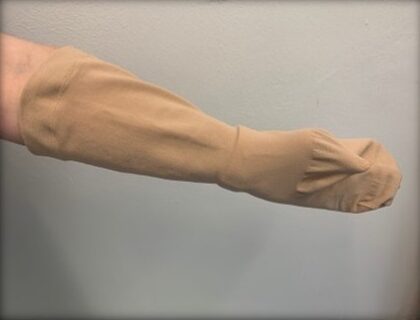
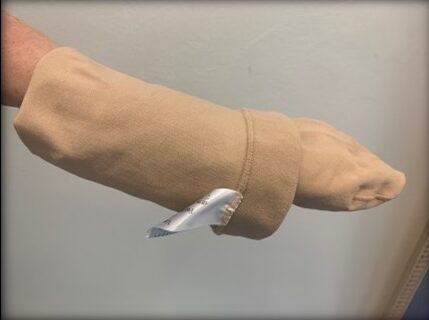
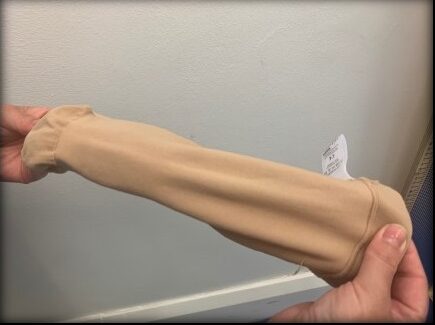
- Using both hands, one each side of the ankle area, pull the fabric over the foot gradually, one section at a time. This will prevent an excess of stocking building up around the ankle and minimise pinching and discomfort
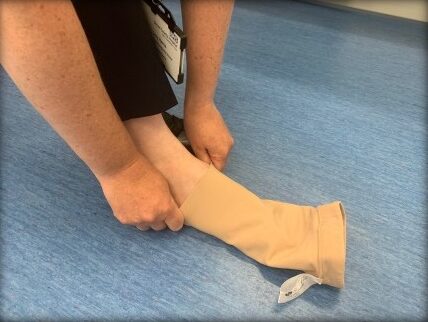
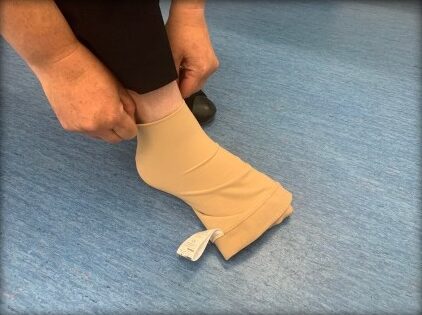
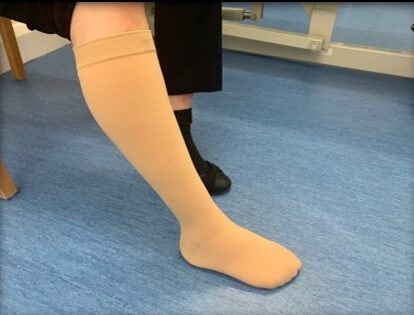
- Make sure the heel is in the correct position before trying to pull the stocking further up the leg. Gradually ease the fabric into position over the leg. If you end up with too much at the top, you have pulled them on too hard. DO NOT turn over the top as this will restrict the blood flow and cause more swelling.
- Make sure that the stocking fabric is spread evenly and there are no folds or creases. Wearing rubber gloves will help massage out any creases and help redistribute the weave of the garment.
- Most people are advised to remove the garments at night (bedtime). Moisturise your skin at night after you take off your stocking. Do not do this in the morning because cream makes the garment more difficult to apply and also will not be as effective in moisturising the skin.
For a useful video on applying and removing compression hosiery please view the following link on YouTube: https://www.youtube.com/watch?v=to-b0zzRaPI
Application devices
There are several application aids available to help you apply your compression hosiery. Please see details below and links to YouTube videos demonstrating their use:
For applying garments:
- Easi-slide (for open toe) https://www.youtube.com/watch?v=77OeZYWBrog
- Acti-glide (for open and closed toe) https://www.youtube.com/watch?v=F2ldp-klaBc
- Magnide (for open and closed toe) https://www.youtube.com/watch?v=orMifUmvj2M
For applying and/or removing garments:
- Mediven 2 in 1 https://www.youtube.com/watch?v=fyiBD8l1Vjk
- Sigvaris Melany https://www.youtube.com/watch?v=0bEzc5vKtn8
- Gardamed Steve+ https://www.youtube.com/watch?v=Q0-o-yL68wc
- Juzo Easyfit https://www.youtube.com/watch?v=lg8L9AltV-E
General care
You will be provided with two garments per leg affected. Your lymphoedema nurse will supply the first pair, and then further supplies through your GP if they are available on prescription. Your nurse will explain the process to you.
- It is recommended to wash the stockings daily, as this not only removes any dead skin cells and bacteria from the fabric, but also returns the garment to its original shape
- Hand wash using gentle soap powder or machine wash (maximum 40°C). Do not use fabric conditioner
- Rinse well in clean warm water or use the spin cycle in the washing machine. Roll up in a towel to remove excess water
- Dry flat away from direct heat. Do not tumble dry.
If you notice a change in the sensation in your leg, particularly when you first start wearing the stocking(s), remove the stocking and contact your lymphoedema nurse. Changes may include:
- Numbness
- Pins and needles
- Change in skin colour/ temperature, particularly if cold/blue/purple
- Pain.
Your legs may be measured at each appointment to monitor the effectiveness of the stockings.
- If you leave the stockings off the swelling may return
- Please wear them to your clinic appointment
- You will need to obtain new stockings every six months; your lymphoedema nurse will explain what to do
- A prescription charge for each item will be made to those who are eligible to pay.
Contact numbers
We hope that you have found this information useful. If you have any questions or are worried about anything, please speak to the following Dorset County Hospital staff:
Lymphoedema Nurses Emma Diaz, Dawn Johnston and Lucy Harris on 01305 255370.
About this leaflet
Authors: Emma Diaz, Dawn Johnston and Lucy Harris, Lymphoedema Nurses
Written: May 2020
Updated and approved: December 2025
Review date: December 2028
Edition: v1
If you have feedback regarding the accuracy of the information contained in this leaflet, or if you would like a list of references used to develop this leaflet, please email dch.patientinformation.leaflets@nhs.net
Print leaflet