
Ascitic Drain / Paracentesis
What is an ascitic drain or paracentesis?
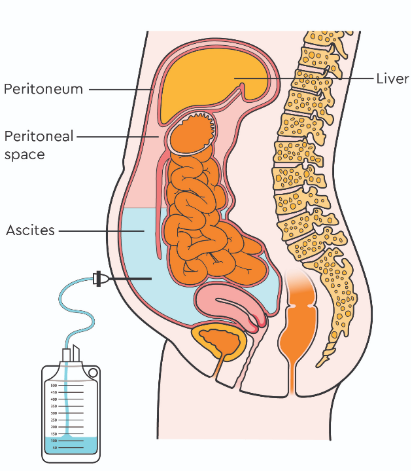
An ascitic drain is a plastic tube that is inserted into the peritoneal cavity in your abdomen. It is attached to a bag on the outside which collects the fluid.
Why am I having an ascitic drain?
Liver cirrhosis is the most common reason for build-up of fluid in the abdomen (ascites). Sometimes medication alone does not get rid of the fluid, so it can build up in your abdomen. Inserting a drain will relieve the discomfort caused by the fluid build-up, it can improve your mobility and appetite.
What will happen?
You will be asked to attend the medical day unit in South Wing Level 0 of the hospital. Firstly, a blood test will be taken and an intravenous cannula inserted into a vein in your arm or hand. You will remain in the medical day unit until the results are available. Once results are available, your doctor or nurse will go through the procedure, ask for your consent, and answer any questions you may have. Your doctor or nurse will use special equipment to find the best place for the drain. You will be asked to empty your bladder prior to the procedure. The drain will be inserted and removed on the same day; you can be discharged shortly after the drain removal. On very few occasions you may be asked to stay in hospital overnight.
How is a drain inserted?
The drain will be inserted by a specially trained doctor or nurse at the bedside. You will be awake throughout the procedure. You will be asked to lie on your back on the bed. An ultrasound machine will be used to find a good position for the drain, usually either the left or right side of your lower abdomen. The doctor or nurse will then put on an apron and sterile gloves. The area marked will be cleaned using an antiseptic solution. A local anaesthetic will then be injected at the marked site. This can sting temporarily but will ensure that the area is numb. Once the local anaesthetic has taken effect, the drain will be inserted. You might feel some pushing. Once the drain is inserted, the drain will be secured with a dressing. Some of the fluid will be sent to the laboratory for analysis.
What happens after the drain is inserted?
After the drain is inserted, the nurses will closely monitor the amount of fluid draining out. Your blood pressure and other observations will be checked frequently while the fluid is draining. You will receive albumin into a vein through your cannula after every three litres drained. If you feel unwell at any time, please inform the nurse or doctor.
How long will the drain need to stay in for?
The drain is removed after you have drained the advised amount of fluid (usually 10-12 litres) or after six hours, whatever comes first. On removal the dressing will be removed and the drain gently pulled out; another dressing will be put over the drain site.
What are the risks?
As with all procedures there are potential risks associated with inserting an ascitic drain. The risk of complications is very small, but bleeding and infection and low blood pressure are possible. You may have some mild pain and the drain site may leak after the drain has been removed. Very rarely there is injury to other organs in the abdomen, including the bowel, liver and bladder, but the use of an ultrasound minimises these risks. There is also a risk that the procedure may fail, in these cases alternatives will be offered.
What then?
We hope your symptoms will improve after the procedure. It may take a few days for the wound to heal. You may need to take some painkillers if you experience any pain around the site. Fluid often collects again after the drain has been removed. This can be managed with absorbent dressings. If your symptoms return in the days or weeks after your ascitic drain, please contact the liver team.
Contact numbers
We hope that you have found this information useful. If you have any questions or are worried about anything, please speak to the following Dorset County Hospital staff:
Liver team: dch.liverteam@nhs.net or 01305 255719
Gastroenterology secretaries: 01305 25 5393/5574
Medical Day Unit: 01305 25 5749
About this leaflet
Author(s): Natalie Miles
Written: June 2025
Approved: October 2025
Review date: October 2028
Edition: 1
If you have feedback regarding the accuracy of the information contained in this leaflet, or if you would like a list of references used to develop this leaflet, please email dch.patientinformation.leaflets@nhs.net
Print leaflet