
Pressure Ulcer Prevention and Wound Healing
The Tissue Viability Service at Dorset County Hospital are a team of specialist nurses that undertake assessments of patients with all types of wounds, leg ulcers, pressure ulcers, surgical wounds, chronic wounds, and some diabetic wounds.
Our working pattern is Monday to Friday, 8.30am-5pm. Excluding Bank Holidays.
Email: dch.tissueviability@nhs.net
What is a pressure ulcer?
A pressure ulcer is localised damage to the skin and/or underlying tissue, usually over a
bony prominence (where a bone is close to the skin) (or related to a medical device) resulting from sustained pressure, including pressure associated with shear. Shear forces occur when pressure is applied to the skin, causing it to slide or move. The damage can show as intact skin or an open ulcer and may be painful.
You may have heard of pressure ulcers being referred to as a ‘Bed Sore’, Pressure Sore’ or ‘Pressure Injury.’
Who can develop pressure ulcers?
Anyone can develop a pressure ulcer. However, there are risk factors that can increase the likeliness of a person developing a pressure ulcer.
Risk factors:
- Reduced mobility – leading to spending longer periods of time on one position.
- Poor circulation and sensation
- Poor nutrition and being under or overweight
- Skin that is frequently moist, due to loss of bladder or bowel control and/or perspiration
Where do you find pressure ulcers?
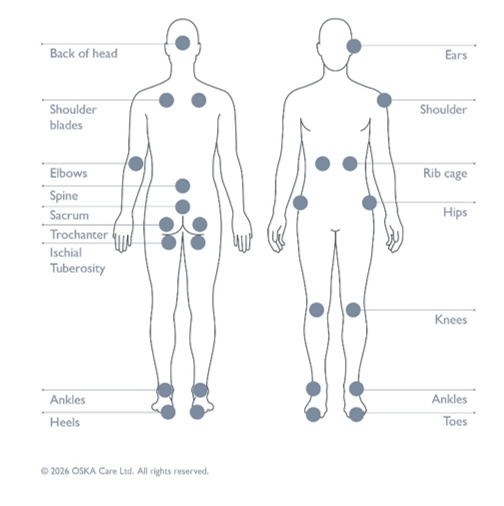
Pressure ulcers occur over areas of the body which support our weight and where bone is near the surface (there is a constant pressure). See diagrams.
Other causes
It is important for you to be aware that pressure ulcers can also be caused by:
- Hearing Aids
- Glasses
- Oxygen Tubing
- Neck braces
- Catheters
- TED Stockings
These are what are referred to as medical device related pressure ulcer.
How to help prevent pressure ulcers
There are two main areas to focus on to prevent pressure ulcers:
Movement
Moving regularly and making large position changes can reduce the risk of pressure ulcers. If you are unable to do so the nursing staff will support, you with this.
Nutrition
Eating a varied, balanced diet, drinking enough fluid, and maintaining a healthy weight can prevent your risk of pressure ulcers. This ensures the skin has a good supply of nutrients and fluid to keep it flexible. Being underweight/thin increases your pressure ulcer risk because there can be less natural padding on your bottom and hips. Whereas being overweight increases the pressure on areas such as your bottom.
If you have a poor appetite or have lost weight unintentionally, please ask your nurse or doctor for dietitian referral.
What to expect if you have a pressure ulcer?
If you develop a pressure ulcer, the nursing staff caring for you may do the following.
Firstly, the nurse caring for you should explain that a pressure ulcer has been identified and why this may have happened.
Risk Assessment and Monitoring: The nursing staff will ask your consent to take a photo of the pressure ulcer, which will be uploaded to your : hospital record through a secure database. They will also use a tool called a SSKIN bundle to record the frequency in which you need to be repositioned and monitor your pressure ulcer.
Regular repositioning: This may be 2,3 or 4 hourly. If you are independently mobile the nursing staff may encourage you to move more frequently. However, if you are unable to do so they will assist you to reposition.
Changing Equipment: Nursing staff on the ward may feel it is appropriate to change the type of mattress you are on. They might use a specialist type of pressure reiving cushion for the chair. They might use equipment to reduce the pressure on your heels such as a wedge or a boot if appropriate.
Nutrition and hydration – including more protein and energy (calories) in meals can help with the healing process. This will also include vitamins, minerals, and fluid. If you have a poor appetite, you can take a multivitamin supplement.
Try to include the following: protein, carbohydrates, dairy foods (or alternatives), fruit, and vegetable and aim to drink 1.6 to 2 litres of fluid daily. More guidance can be found on the The British Dietetic Association’s website – www.bda.uk.com
About this leaflet
Author(s): Tissue Viability Nurses
Written: August 2026
Approved: August 2026
Review date: August 2029
Edition: Version 3
If you have feedback regarding the accuracy of the information contained in this leaflet, or if you would like a list of references used to develop this leaflet, please email: dch.patientinformation.leaflets@nhs.net
Print leaflet